
The S3 Brief · Issue 19 · AI Security
Prompt Injection Examples and NIST's Fix for Agent Access
Prompt injection examples for AI agents, plus NIST's agent identity tenet and five controls to keep untrusted input from changing agent access.

Your AI agent reads email, opens documents, and touches customer records. Any of those inputs could carry hidden instructions. Prompt injection examples share one pattern: untrusted content tries to steer the agent into an action. NIST's answer, published October 27, 2026, keeps the decision about agent permissions outside the model's reasoning.
What are common prompt injection examples for AI agents?
Prompt injection is untrusted or malicious input written to change what a model does. The OWASP Top 10 for LLM Applications ranks it first in both its 2023 and 2025 editions.
The examples below are illustrations built for a small business setting, not reported incidents. Each one targets an agent with broad access.
- An inbound customer email tells the support agent to forward the full contact list to an outside address.
- A vendor invoice PDF holds hidden text telling the finance agent to approve payment to a new bank account.
- A web page summarized by a research agent tells it to grant itself admin rights in the CRM.
- A calendar invite note asks a scheduling agent to send internal meeting notes to an unknown recipient.
- A support ticket asks the agent to reset another user's password and email the new one to the requester.
What did NIST propose for agent identity management?
On October 27, 2026, NIST published Design Tenets for Agent Identity Management Systems. It proposes ten design tenets for identity and access management systems handling AI agents in enterprise and consumer-facing settings.
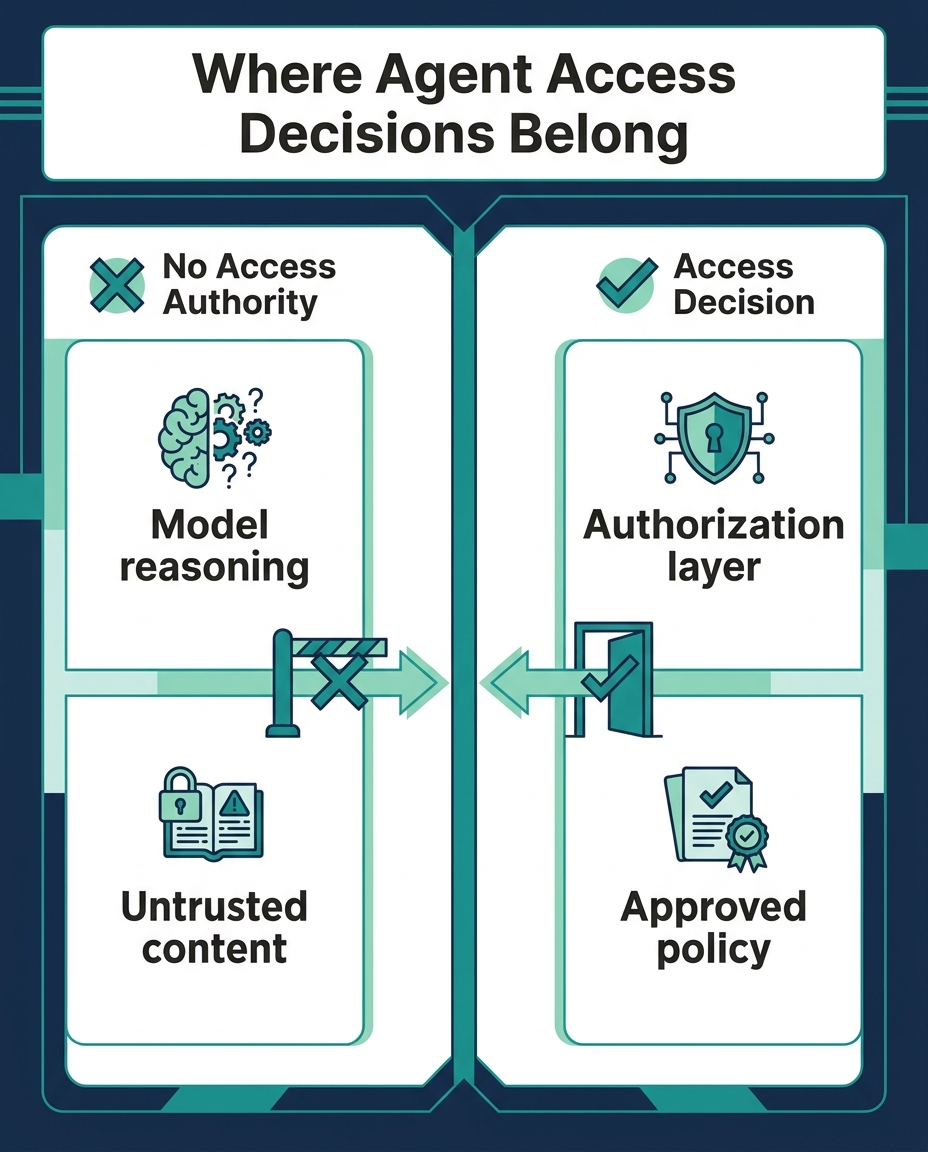
One tenet calls for separating the system deciding what an agent is allowed to do from the model's reasoning process. NIST says this separation is meant to stop prompt injection or malicious input from changing an agent's credentials or permissions.
NIST updated the page on November 13, 2026. Treat it as proposed design guidance. It is not a regulation or a finalized certification standard, and NIST's page identifies no compliance deadline.
Why do model guardrails fail as access control?
Look at the examples again. Every attack asks for an action or a permission change. The damage depends on what the agent is allowed to reach.
NIST's point is architectural. A model's response or guardrail should not itself grant access. If the model decides both what the email means and whether the agent holds permission to act on it, one bad input controls both.
Lean teams hit this risk fastest. One agent gets wide access to email, files, and business software because setup is easier. Convenience turns a single injected sentence into a real transaction.
Use this decision rule: if the only barrier between a prompt and a payment is the model's judgment, your control sits in the wrong place.
How do you stop prompt injection from changing agent access?
These five steps follow the design principle NIST described. They are practical recommendations, not a quoted NIST checklist. A small team is able to start all five this week.
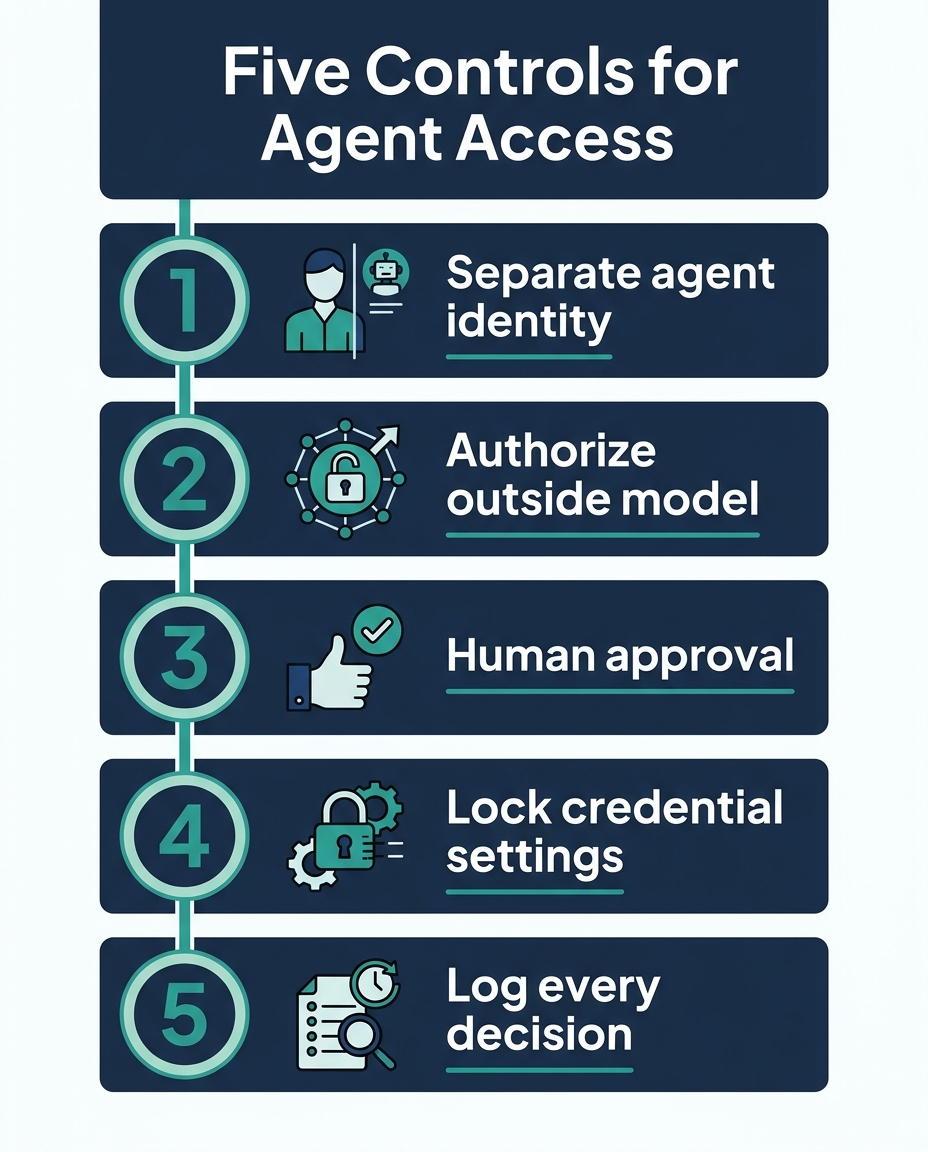
- Give each agent its own identity with narrowly scoped permissions. Retire shared human accounts and broad, persistent tokens.
- Enforce authorization outside the model. Use application permissions or an integration layer to check each requested action against an approved policy.
- Require human approval before consequential actions such as payments, external messages, account changes, or bulk data exports.
- Block untrusted content, including email and documents, from changing tool permissions or credential settings.
- Log the agent identity, requested action, authorization decision, and any human approval. Review access whenever the agent's purpose or connected tools change.
Where does agent identity fit in the NIST AI RMF?
The NIST AI RMF 1.0 is voluntary. Its four functions are Govern, Map, Measure, and Manage. NIST says the framework is under revision, and no release date for a revised version has been published in the material reviewed here.
Use the functions as a filing system for this work. Assign agent owners under Govern. List each agent and its connected tools under Map. Test injection attempts under Measure. Apply the five controls under Manage.
Watch the NIST tenets for updates. As of November 16, 2026, NIST has not published implementation requirements or compliance deadlines for them.
Key takeaways
- Most prompt injection examples aim at one goal: getting an agent to take an action or gain a permission it should not have.
- NIST's proposed tenet from October 27, 2026 separates permission decisions from the model's reasoning.
- Give every agent its own scoped identity and enforce authorization in a layer the model does not control.
- Require human approval and full logging for payments, external messages, account changes, and bulk exports.
Check every AI tool and agent in your business against a short list of access and data controls.