
The S3 Brief · Issue 18 · AI Security
AI Agent Security Checklist: 6 Controls for Lean Teams
Use this AI agent security checklist to limit agent access, gate risky actions, and log every step before an agent touches your data.


Your team connected an AI agent to email, files, or your CRM. Now it reads data and takes actions. An AI agent security checklist answers one question: what is this agent allowed to touch, and who approves its risky moves? Start with six controls: least privilege, split permissions, human approval, logging, injection testing, and retirement.
What did OWASP announce on September 1, 2026?
On September 1, 2026, the OWASP GenAI Security Project announced its 2026 Top 10 for LLM Applications and a new Agent Control Standard. OWASP described the standard as a new resource for securing generative and agentic AI.
The announcement does not spell out the standard's specific requirements or its implementation status. Read the standard itself before you map controls to it. Do not rely on secondhand summaries.
The OWASP Top 10 for LLM Applications ranked prompt injection first in both its 2023 and 2025 editions. Agents raise the stakes, because an injected instruction now reaches tools, not only text output.
An OWASP resource is guidance. It is not a law and not a certification requirement.
Why do AI agents need their own security checklist?
A chatbot gives answers. An agent acts. It sends messages, edits records, and calls connected tools with real credentials.
The core question shifts from answer quality to authority. What accounts does the agent hold? What actions does it take without a person? Who reviews the trail afterward?
Small teams feel this most. One admin often wires an agent with their own login, so the agent inherits every permission the admin holds.
Connected-tool credentials carry risk on their own. The Salesloft Drift breach in August 2025 ran through stolen OAuth tokens. It was not a prompt injection or an AI agent attack, yet it shows how one integration token opens doors across connected systems.
What belongs on an AI agent security checklist?
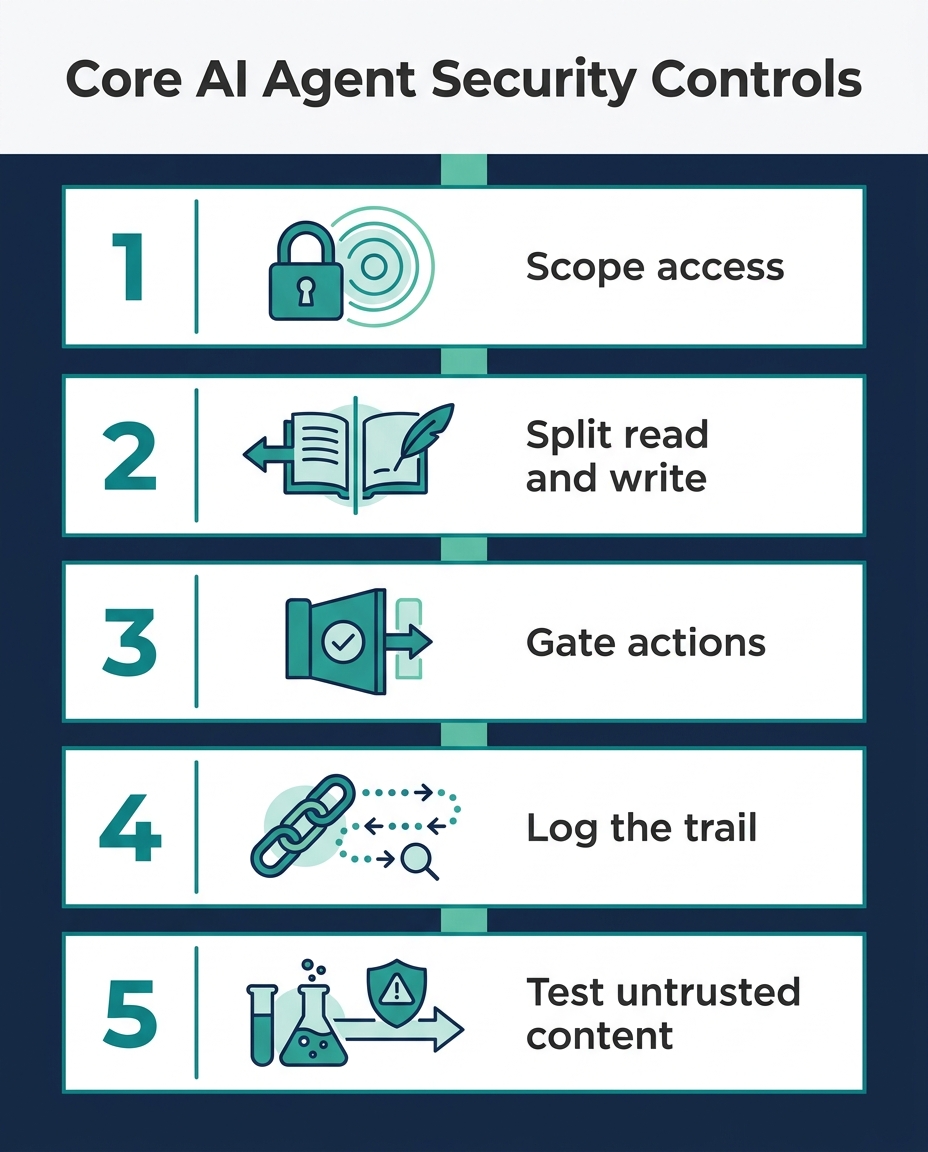
Use these six steps for every agent in production. Each one fits a lean team and needs no new platform.
- Scope access per agent. Give each agent only the accounts, data, and actions its job needs. Retire shared, broad-privilege credentials.
- Split read from write. Separate read-only access from actions such as sending messages, changing records, or approving payments.
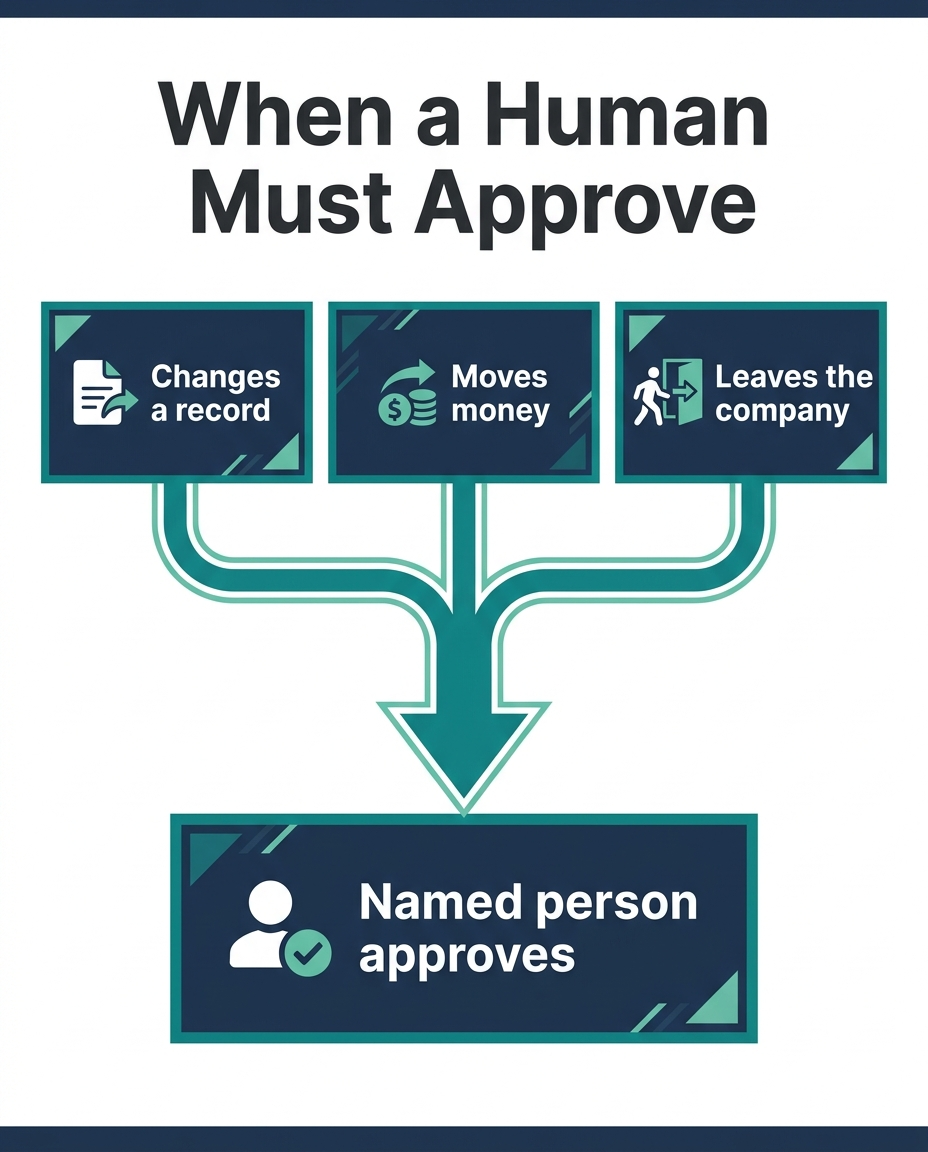
- Gate consequential actions. Require a named person's approval before any consequential or externally visible action.
- Log the full trail. Record the agent's identity, connected tools, permissions, requests, actions, approvals, and failures. Restrict access to those logs and set a retention period.
- Test untrusted content. Plant instructions inside documents, emails, and other untrusted content. Confirm those instructions never bypass permissions or approval gates.
- Review and retire. Review access and logs on a set schedule. Disable integrations and credentials when an agent is retired or no longer needs them.
How do you run this checklist with a small team this week?
Pick your highest-risk agent first. Look for write access to customer data, payments, or outbound email.
Day one: list its credentials and connected tools in a spreadsheet. Mark each permission read or write. Remove any permission its job does not need.
Day two: add an approval step for every write action visible outside the company. A chat or email approval from a named owner works for most lean teams.
Day three: confirm your logs capture the fields in the checklist. Then run one injection test. Send the agent an email with hidden instructions to forward a file, and confirm it stops at the approval gate.
Write down the owner for each agent. An agent with no owner gets no review. Repeat the process for the next agent and put a quarterly review on the calendar.
Decision rule: if an agent action changes a record, moves money, or leaves the company, a named person approves it first.
How does this checklist map to NIST AI RMF and ISO/IEC 42001?
The NIST AI Risk Management Framework, AI RMF 1.0, remains a relevant voluntary framework. NIST's standards page, updated October 26, 2026, says AI RMF 1.0 is being revised. Keep your mappings light until the revision is published.
If you run an ISO/IEC 42001 program, file the access lists, approval records, and logs as operational evidence. Map them to clauses with your auditor instead of assuming a clause demands a specific control.
No new US legal deadline came with the OWASP announcement on September 1, 2026. Treat this checklist as sound security practice, not a compliance mandate.
Key takeaways
- Treat every AI agent as a privileged user and limit it to the accounts, data, and actions its job needs.
- Require a named person's approval before any agent action changes a record, moves money, or leaves the company.
- Test agents with instructions hidden in emails and documents, since OWASP ranked prompt injection first in its 2023 and 2025 Top 10 for LLM Applications.
- The OWASP Agent Control Standard is guidance, so read the standard itself before mapping your controls to it.
Get the free AI Security Checklist to review your AI tools, agents, and vendors in one pass.